Ritual Schools
| Art | Schools |
|---|---|
| Abyssal Art | ABYSSAL ‡ SATANIC |
| Divine Art | AETHER ‡ CELESTIAL |
| Witchcraft | WITCHCRAFT |
Abyssal Art
The death school and the satanic school are the sources of abyssal fragments, governed by the Abyssal Rituals skill. Connected to unlight and the dark forces of the Abyss.
Death School
SACRIFICE ‡ HALLUCINATION ‡ LINGERING ‡ WORLD-ALTERING
The heinous means for reaching out to greater entities, transcending the reality of Fracture and defying the nature of Satan himself. In order to accomplish this, death rituals draw power from death itself instead of relying on aether and unlight.
The fallen beings of the Satanic Court use death rituals as a means of gaining power, communing with powers beyond. The death rituals of the True Unlight can last for days, and often include many sacrifices of different kinds. In general, the Ancients despise these vulgar and abominable rituals, and many react harshly to being contacted in such ways, but some, like Thor, Apollo, and Hecate are known to use death rituals to communicate with other entities.
In contrast to other schools, casting a death ritual is always a complex task, coordinated by you but performed by the whole party. It often involves sanctifying the ritual location by drawing symbols and patterns on the ground, chanting psalms in long forgotten languages, and using paraphernalia like incense, candles, and other catalysts – all of which are based on the entity being communed with. Finally, at least one sacrifice is required, although it is advisable to go for more, depending on how much control you want to have over the outcome.
In order to cast a death ritual, resolve the steps for casting a ritual in the Casting section with the modifications indicated below:
1. In the first step, only declare a single entity fragment, nothing else.
2. In the second step, declare that the intended effect of the ritual is an audience with the entity. This makes it official that you’re choosing to perform a death ritual.
3. Ignore the third step. Instead, the party resolves a complex task requiring 10 successes, where each check is about an hour long. Any failures or botches accumulate negative aspects or truths that relate to the audience with the entity. Additionally, at least one sacrifice must be made in order to complete this complex task.
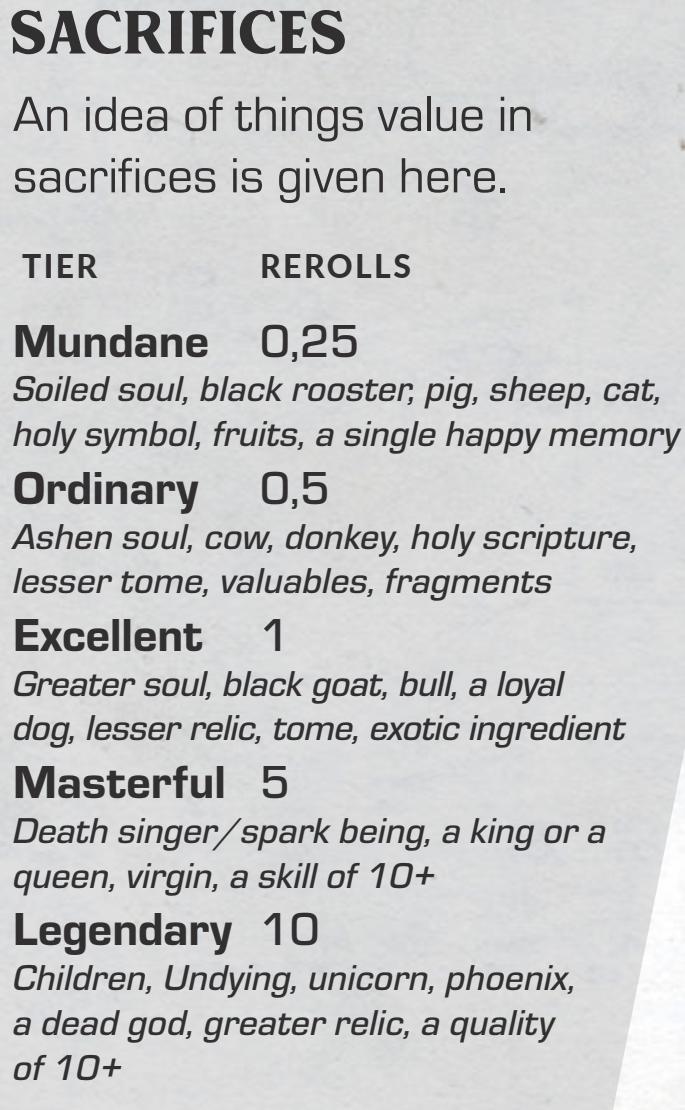
When the third step is finished, immediately generate the two other fragments by rolling 1D6 on the second and third columns of the death fragments table, below. You may reroll a fragment for each sacrifice made beyond the first (four mundane sacrifices allow you to reroll once, etc.), and must keep the new result – or reroll again if you still have any rerolls remaining.
With the three fragments determined, you – and, possibly, the party – have an audience with the entity, which is carried out in the same way as a successful spontaneous audience (explained in the Audiences chapter). The outcome will entirely depend on the entity’s personality, the fragments used, and the negative truths or aspects accumulated while performing the ritual.
One might wonder if it is a good idea to abandon a death ritual without finishing it, if too many negative truths and aspects are accumulated. No records remain of souls who have tried. What could possibly have happened to them?
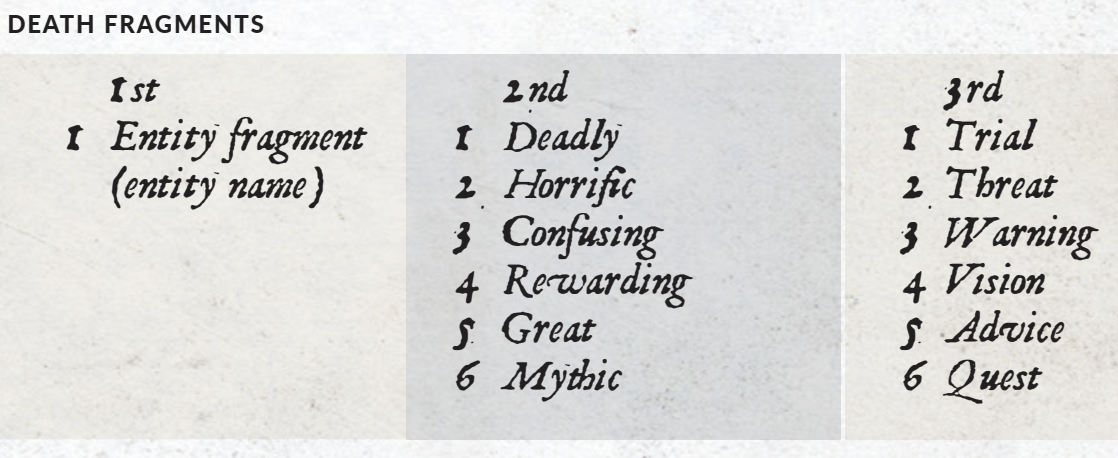 Death school fragments can never be used as daily or improvised fragments. Additionally, you can only learn fragments from the first column of the death school, which are always entity fragments – that is, names of entities. Death fragments are often buried deep in forbidden tomes or artifacts and protected by powerful guardians, cursed or damned to an eternal vigil.
What if an entity you meet through a death ritual wants you as their champion? How would the entities fight over you, and would your master change? GM knows.
Tip
Death Ritual Example
The Defiler has learned the death fragment “The great Yog-Sothoth” and is casting a death ritual trying to get an audience with this entity. She resolves the complex task and gets one failure in a Dominion check before succeeding, which will influence the audience with a negative aspect. The sacrifice is a necronaut she captured earlier whose throat is cut with a ritual dagger.
The Defiler rolls 2x 1D6 to get the final two fragments and the result isn’t the best: Horrific + Trial. The GM interprets the result and decides the trial is a test she must undergo before meeting the entity. They describe how the body of the necronaut disintegrates into a bloody storm, plunging The Defiler into a glowing void that burns her eyes. A voice pierces her brain and sends pain through all of her remaining synapses. “You seek the doorway, little thread of flesh? You seek oblivion?”
She is suddenly standing in a dark labyrinth below a sky filled with impossible colors, like a nuclear explosion trapped in time. The walls and floors are filled with abhorrent, aggressive caterpillars, mandibles piercing her legs and feet as she starts to run through this twilight nightmare. f she succeeds in this trial, she will get her audience that still will be influenced by the negative aspect because of the one failure in the complex task.
Satanic School
HARROWED ‡ EVIL ‡ GROTESQUE ‡ SICKENING
The ways of tampering with dark powers, evil and hostile, with near-sentient attributes. Smaller inanimate things often come alive for a while in the surroundings of satanic rituals, like dust flies and shrapnel roaches creeping around and leaving traces of unlight behind them. These unusual rituals often induce fear in both the targets and the caster. Most of the satanic casters are True Unlight beings, but there are also mystics and witches who seek and wield this power, drawing applause from the Satanic Court and loathing from the Ascended.
Casting a satanic ritual is loud and chaotic, and the casters often scream and curse while using paraphernalia of a repugnant nature, like hearts, eyes, and genitals. In addition, lots of blood tends to get thrown around or drawn into symbols on the ground. Satanic casters often carry around a small pharmacy of yucky stuff needed to make their rituals work. Satanic rituals are instantaneous and very violent in nature, inflicting grotesque and horrific effects on the victim. Unintended side-effects are common, often serving to frustrate the caster.
Failing a satanic ritual is obviously dangerous, considering that just casting it is already a risky undertaking. Most of the time the ritual will take sentient form, with unlight compressing the threads of reality to the point of giving it a horrific, multidimensional, paraphysical form. What happens next really depends on what form the now-sentient ritual has taken. It can turn out to be aggressive, shy, curious, and even playful, but almost always in a jittery and uncontrollable way, leaving desecrated pathways of blood, maggots, guts, or skin growing out of the very ground around it. Botching a satanic ritual will most likely create a hostile, rampaging creature, usually resulting in the caster’s death unless a miracle occurs.
Tip
Satanic Ritual Example
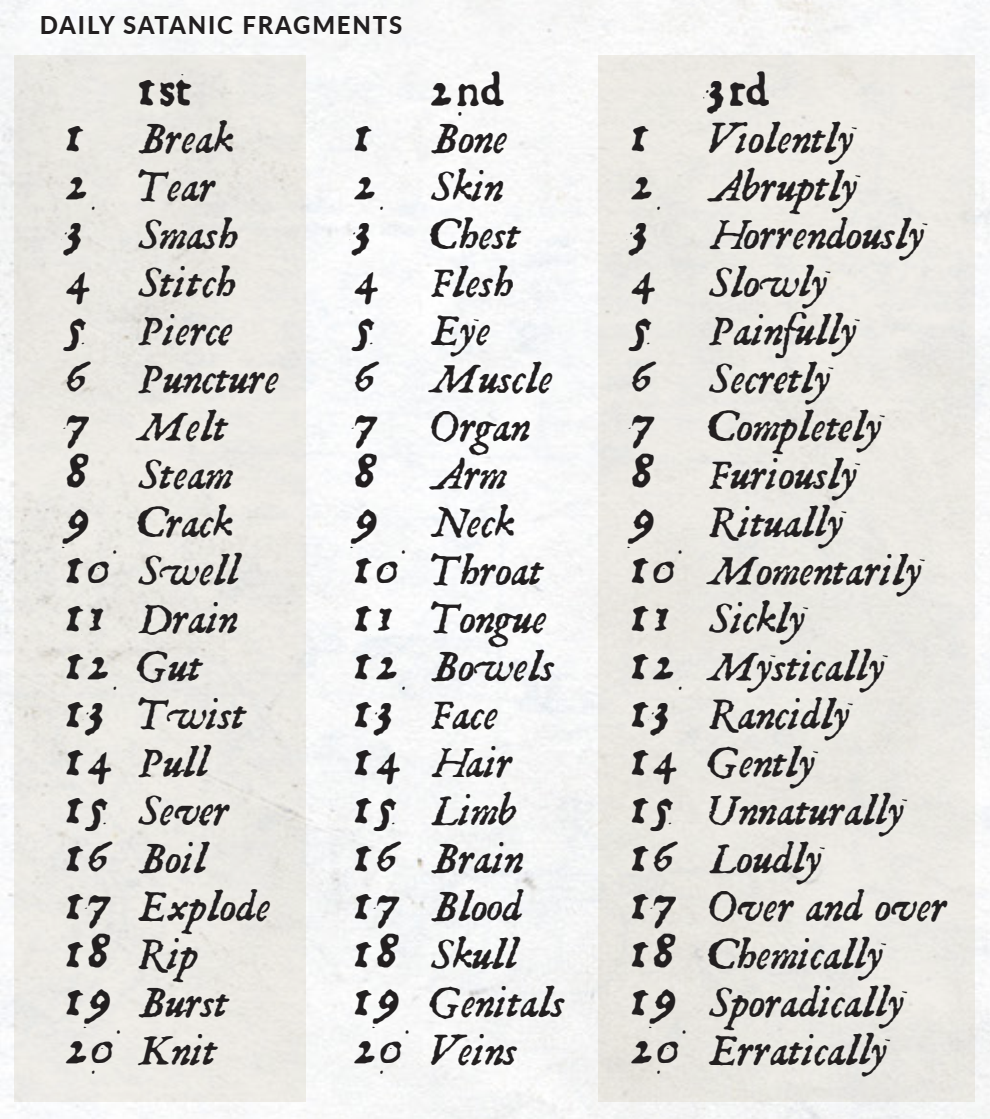
The Black Priest wants to cast a ritual using his learned fragments from columns 2 and 3, Spine + Mercilessly. Since he is out of other fragments, he rolls an improvised fragment for column 1 and pays 1 [SAN]. He rolls “Drain,” giving him Drain + Spine + Mercilessly. He explains that his intention is to weaken a centurion his party is fighting by emptying its backbone of all liquid. He rolls for Abyssal Rituals and gets a success, and the two learned fragments add 2 [+].
The GM describes how the centurion screams in pain as his spine is drained and says that he is visibly weakened. (In secret the GM also counts the ritual as a damage 4 attack with no bones subtracted.) The Black Priest wants to use the 2 [+] to introduce the aspects “dropped his weapons” and “blinded by pain”, to further enhance the effect, giving his party lots of opportunities to finish the fight.
Divine Art
The celestial school and the aether schools of salt, sulfur, and mercury are the sources of divine fragments, governed by the Divine Rituals skill. Connected to aether and the mysterious forces behind everything divine.
Aether Schools
LEMENTS ‡ BODY ‡ SOUL ‡ SPIRIT
The applications of aether and the divine nanotech in reprogramming reality, which directly affect the surroundings by twisting angles and forces, to the point of making things like gravity or distance uncertain for a short while. Aether mystics are often more powerful than other souls would feel safe around, and are viewed with suspicion by almost everyone, from the golden blooded to the True Unlight. Mystics of aether are often tainted by their ritual usage in looks, mood, and smell, which makes it very rare for an aether mystic to successfully hide their true nature.
Casting an aether ritual is very conspicuous, usually igniting the air as you draw a burning symbol in front of you, or creating other prominent light and sound phenomena. These symbols and sparkles are visible to everyone around, who will easily understand what is going on unless you hide the ritual somehow. An experienced mystic can even read such phenomena and interpret the general programming, getting a sense of what is about to happen – or even what has happened before – by examining the sensorial traces left in the air. Divine rituals are instantaneous, unless the GM deems otherwise.
Failing or botching an aether ritual always results in instantaneous and unpredictable effects, such as elements going berserk, ripping body parts off of characters and adversaries alike (salt), people turning wildly insane and attacking their friends (sulfur), or fate playing tricks on a character, making their future dramatic and dangerous (mercury). Botches also have a lingering effect on the area for weeks or even years after, making it either unpleasant, dangerous, or in some rare cases, actually nice…
As they entered the small house surrounded by darkness, The Defiler sensed something in the air. A certain smell, a vague shimmer that tingled her sensitive arcane senses. “Some kind of ritual was cast here, I can hear wailing voices. A very clumsy mystic… A judge demon!”
There are three aether schools:
- salt (body)
- sulfur (soul)
- mercury (spirit).
Salt
Salt is the body and the physical world, the shell of all souls. Salt rituals are some of the most common, mostly performed to create physical effects out of thin air. Their effects are remarkably spectacular, with elements, colors, and lots of sounds and noise.
Tip
Salt Ritual Example
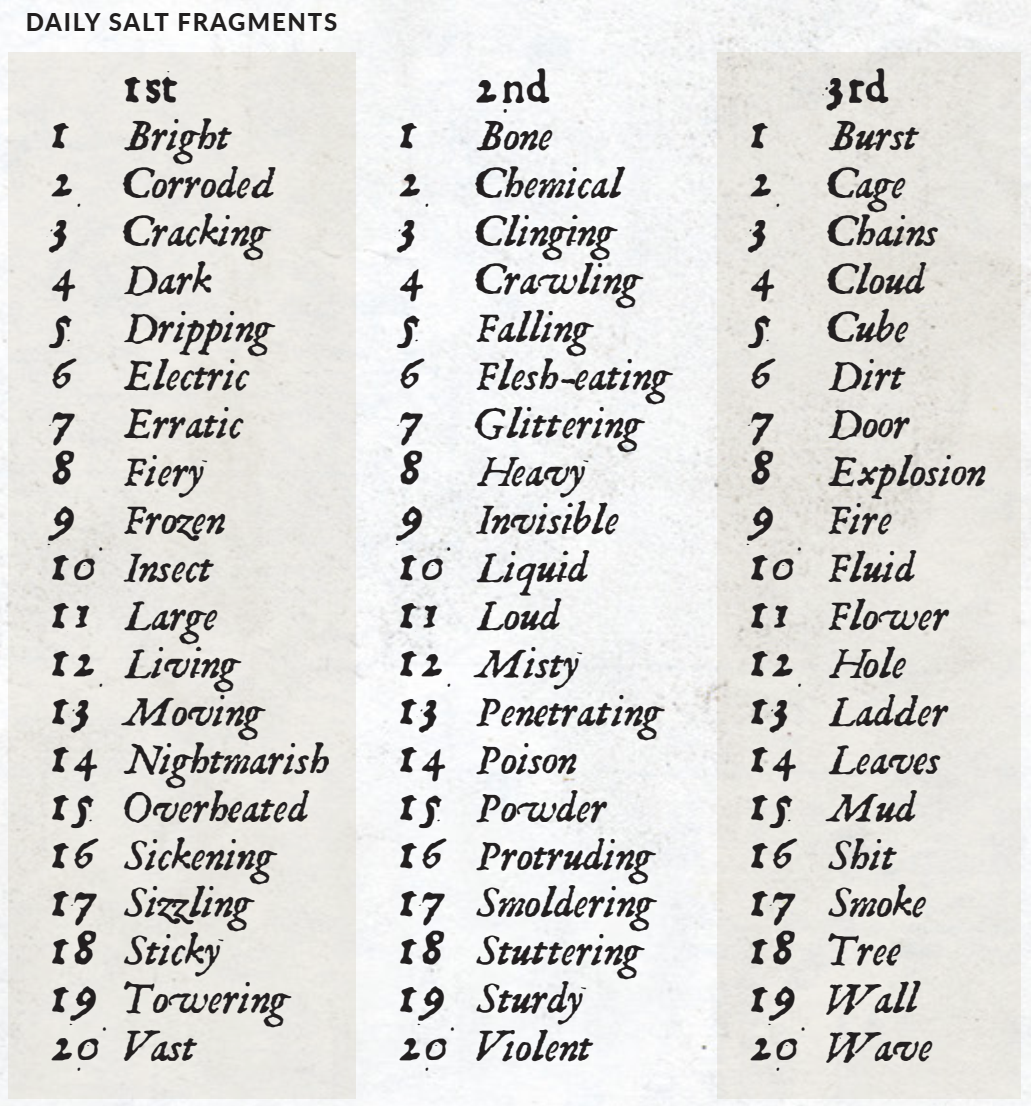
The Defiler is infiltrating a Haxan fortress and wants to cast a completely improvised ritual. Rolling the three fragments Insect-like + Sturdy + Leaves she explains that she intends to make large cockroaches fall from the sky like leaves to cause confusion. She loses three [SAN] (one for each improvised fragment) and rolls for Divine Rituals, but fails making her lose a [AUR] also, since she wants to affect the physical world.
The insects that start to fall from the sky are actually large burning dragonflies, scorching the Defiler and her party, giving them the negative aspect “scorched and smoking”. The fireflies brings confusion to the fortress but also illuminate the night in a bright burning glow.
Sulfur
Sulfur is the soul and the personality, the will and aspiration. Sulfur rituals focus on changing someone’s motivations, ideas, or desires. Often used to manipulate and trick but using the target’s position or network it can become very powerful magic. Because they are aether rituals, there is often a need for some kind of distraction when using them on unwilling targets.
Tip
sulfur ritual example
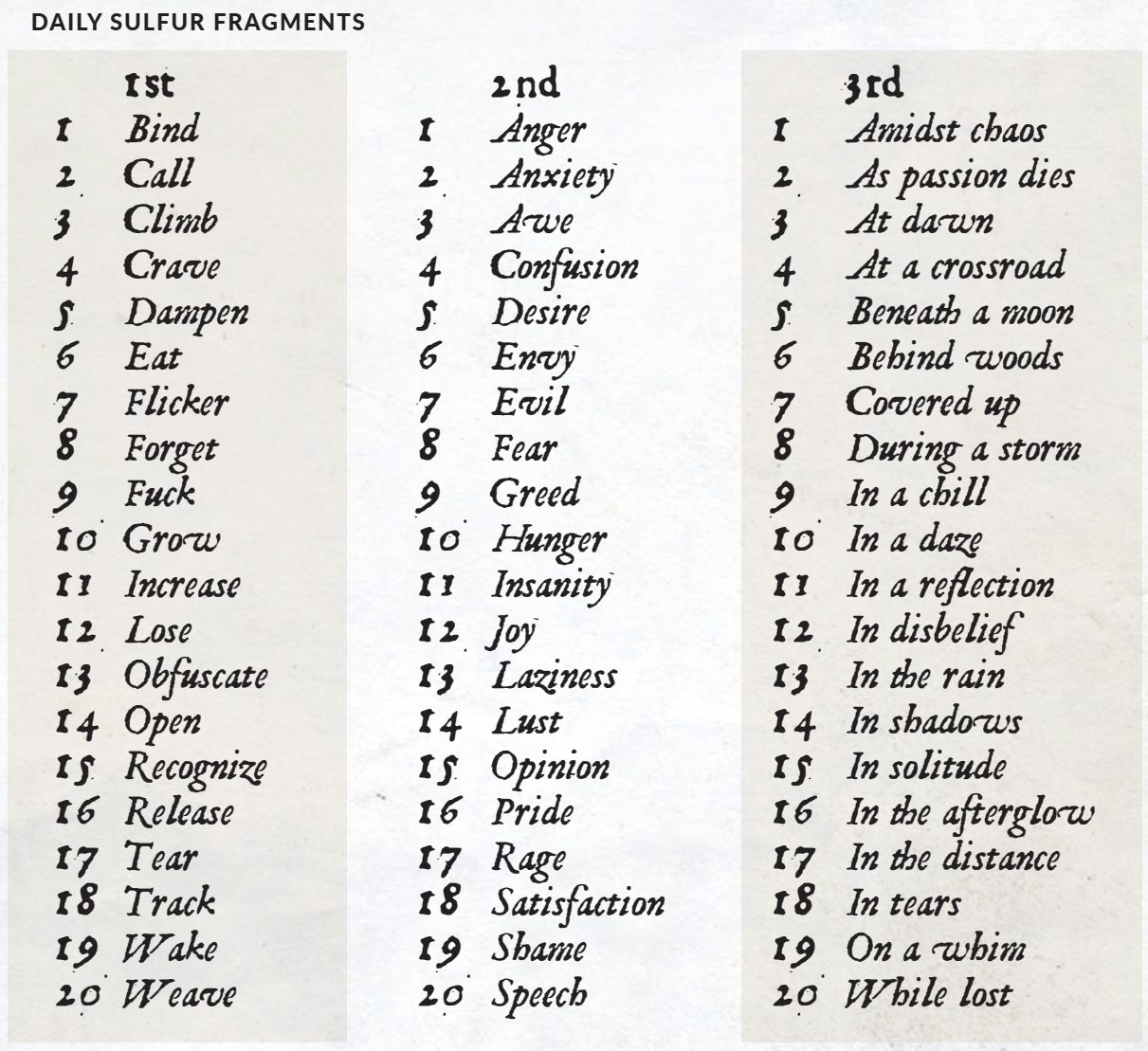
The Summoner is casting a ritual using daily fragments Grow + Opinion + On a whim, with the intent to change a satanic bureaucrat’s opinion about the party. He succeeds with 2 [+] and the GM describes that the bureaucrat turns around with a friendly glint in his eye. The Summoner wants to use the 2 [+] to create the supernatural aspect “sudden change of mind” and the bureaucrat starts to explain that the expedition to the lost temple maybe isn’t such a bad idea after all.
Mercury
Mercury is the spirit and the divine connection with the Eternals that all beings possess. Mercury rituals focus on altering someone or something’s destiny by changing the events unfolding before them. Just like celestial rituals, only their intent is controllable by the mystic, timing and final effect is up to fate. Mercury rituals can only have one target and, being an aether ritual, they are far from invisible.
Tip
Mercury Ritual Example
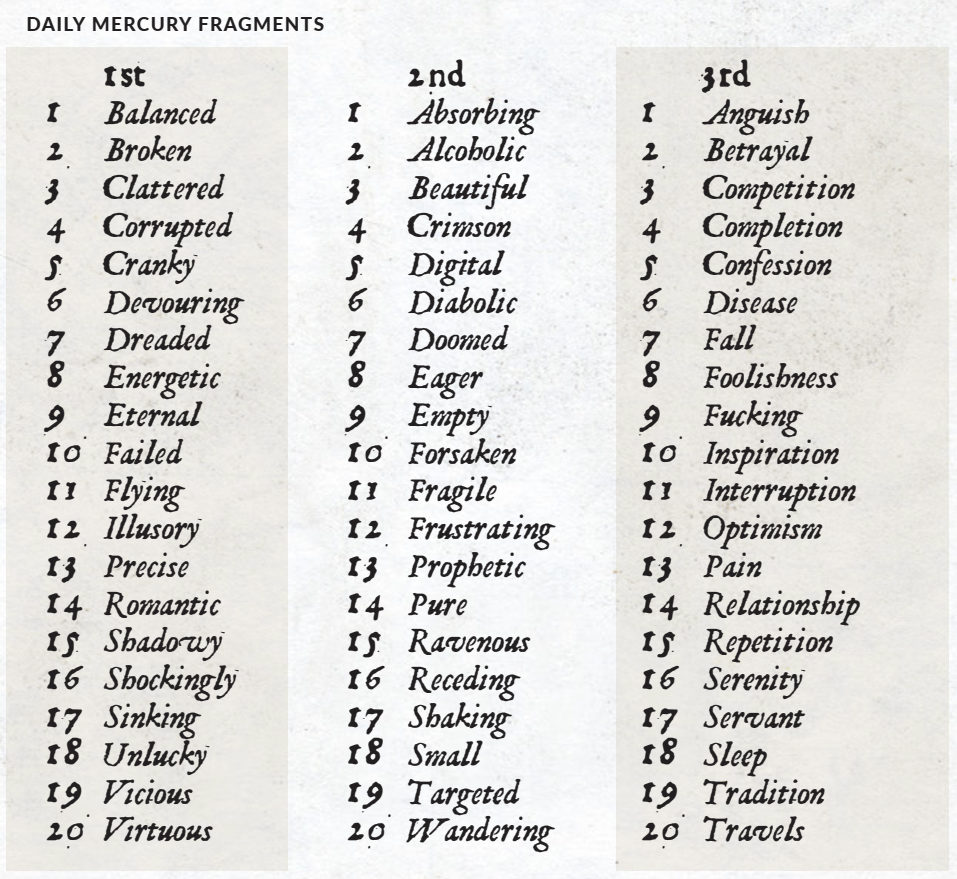
Broken + Alcoholic + Relationship cast upon the Crimson Baron with the intent to split up his marriage, starts a heated argument between the baron and baroness the following evening, ending with their dining room in shambles, the baron wasted and passed out in the cellar and the baroness crying her heart out together with her 12 maids and the kitchen staff.
Celestial School
DESTINY ‡ FATE ‡ MIRACLES ‡ INTERVENTIONS
The source of the so-called heavenly rituals, which never affect the physical world directly but instead change causality and the way events unfold. Celestial mystics are called miracle workers or false prophets, depending on who’s doing the calling, either seen as wise souls contemplating the future of Fracture or as maniacs creating even more chaos and mayhem. Due to their strong connection with divine forces, the Satanic Court relentlessly hunts for them, corrupting them into satanic sirens or truth hags of the True Unlight in order to use them in the great game of power. Most mystics regard such a fate as the single worst thing that could ever happen.
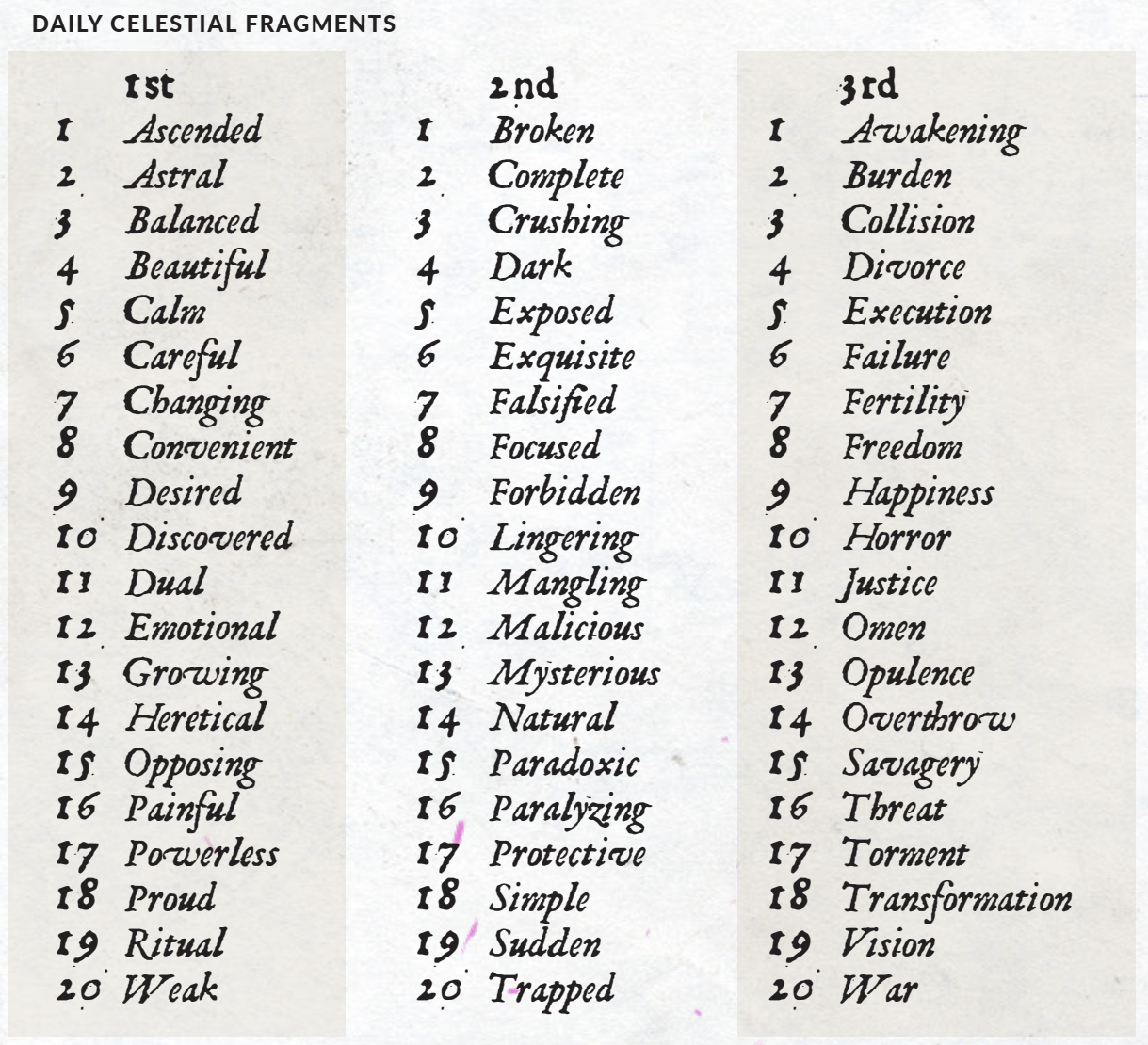
Casting a celestial ritual is invisible to the naked eye, although you usually recite psalms and close your eyes during the casting. Often, the result of a celestial ritual won’t be noticeable – not even for you – until the desired events come true, and the exact way in which these events happen is often a surprise, as it is completely in the hands of the divine forces. The time it takes for celestial rituals to take effect is also totally uncontrollable, only subject to father Fate and mother Luck (and aunt or uncle GM).
Failing a celestial ritual is, like it’s conjuring, also invisible. The feeling that something went wrong is unshakable and, not only do you feel that your intentions won’t come to fruition, but that they’ll be changed into something completely different.
Tip
Celestial Botch
Clockers Street in the Citadel’s lower regions has a section where horrible accidents happen over and over. Wagons running over the edge of bridges and tumbling down the shafts, workers accidentally dropping heavy materials on top of souls passing by and killing them, and even an inquisitor of the Satanic Church falling through a rusty manhole cover, crushing his skull and dying instantly. When summoned from death, the inquisitor started an investigation and figured out that a celestial mystic must have cast a ritual where he wanted something to fall in the area, but clearly botched it up disastrously, cursing the street for an unforeseen time period. Clockers Street is now closed to the public, but still has a fairly large number of visitors from members of the Temple of Accidental Deaths.
Witchcraft
The witchcraft school is the source of witchcraft fragments, governed by the Witchcraft skill. Connected to both aether and unlight, in a very carnal and amoral amalgam of life, unlife, hell, heaven, and everything in between.
Witchcraft School
LIFE ‡ DEATH ‡ SEX ‡ NATURE
The powers of life and death within the containment of human grasp – birth, aging, growing, and dying. Often organic and sexual in nature, witchcraft rituals have a gritty and rustic feel to them and generally end up taking grotesque forms. Most witches are very closely tied to alchemy tech, often creating familiars that aid them in their daily tasks. They are usually outsiders in the whole good and evil quarrel, not attracting much attention from either side.
Casting a witchcraft ritual is messy, using pre-made catalysts like potions, powders, and chemicals, often also quickly sacrificing smaller lifeforms like rats or birds, all while chanting, murmuring, dancing, eating, drinking, and doing all kinds of weird stuff. Witches often value dimension bags very highly, preferably those that can keep animals alive, due to their need for a large inventory of ritual paraphernalia. Witchcraft rituals are instant, unless the GM deems otherwise.
Failing a witchcraft ritual creates unforeseen curses that can take both horrendous and comical forms. Making someone pregnant regardless of their form or sex, growing someone’s limbs out of proportion, turning body parts into plants or changing the places of said body parts, and the list goes on. These curses are seldom outright dangerous, but may lead to anything from personal difficulties to suicide for souls who want to get rid of them. Curses never affect the witch unless there is no other sentient being nearby, which is why witches almost always keep pets or create familiars with alchemy. With a botch, these curses are made permanent, otherwise they remain for a duration, fitting the story.
Tip
Witchcraft Ritual Example
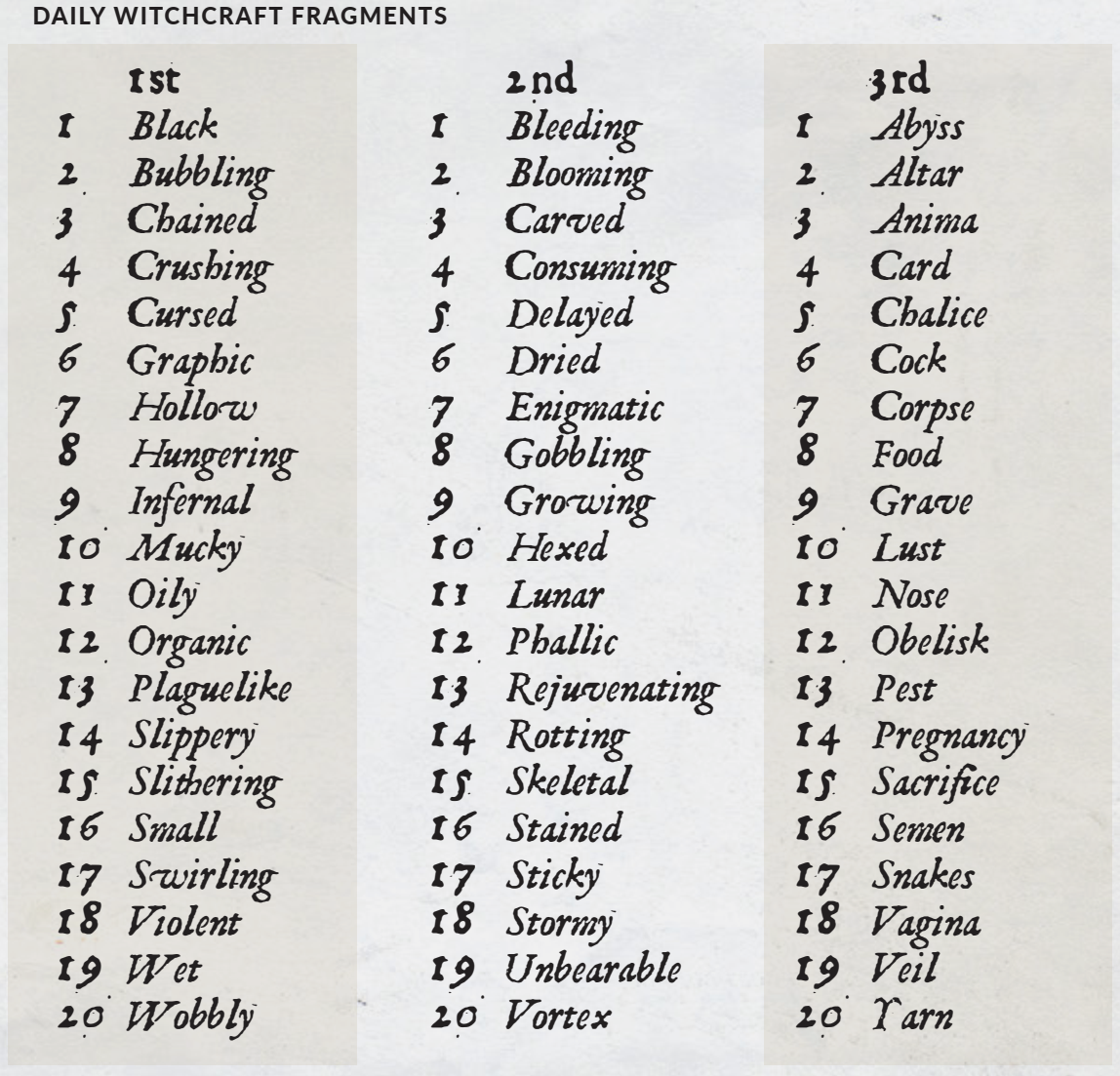
Being in need for some high quality consumables, the gingerbread witch Athraxia wants to summon a magical oven that can create delicious, luxurious candy. She has three fragments for the ritual, Heated + Sweet + Oven, and her GM suggests this is a longer ritual treated as a complex task with a difficulty of 10.
Athraxia rolls a total of seven checks with different skills failing one and botching another before completing, and the GM decides this means the ritual takes a total of seven hours to complete.
The GM decides the oven can create five Luxurious food consumables each night and that it will be around until next full moon. The negative aspect about this oven is that it is a smoky and inhospitable thing to work with, draining 5 [SAN] from the operator each evening. The negative truth is that 1 out of 10 candies it makes tastes really bad, and there is no way to determine which one until consumed.