Rituals
Mystics and witches have a spiritual connection with the primordial forces of aether and unlight. Some of them can see the substances themselves as traces or trails, while some can sense them like forces flowing through their bodies. As the divine nanotech of the genesis merged with everything else during the Rapture, it was also infused into aether and unlight themselves, making them somewhat controllable with the right tools. Casters use their own minds to end the arcane forces into the shapes and forms they want.
There are seven schools of rituals, all governed by the Arcane Arts skill tree. Each skill in the tree governs one or more schools, except for Alchemy Tech which is a whole different thing. Casters usually dabble in several of the schools at once, although there are some who prefer to specialize in a certain school.
Fragments
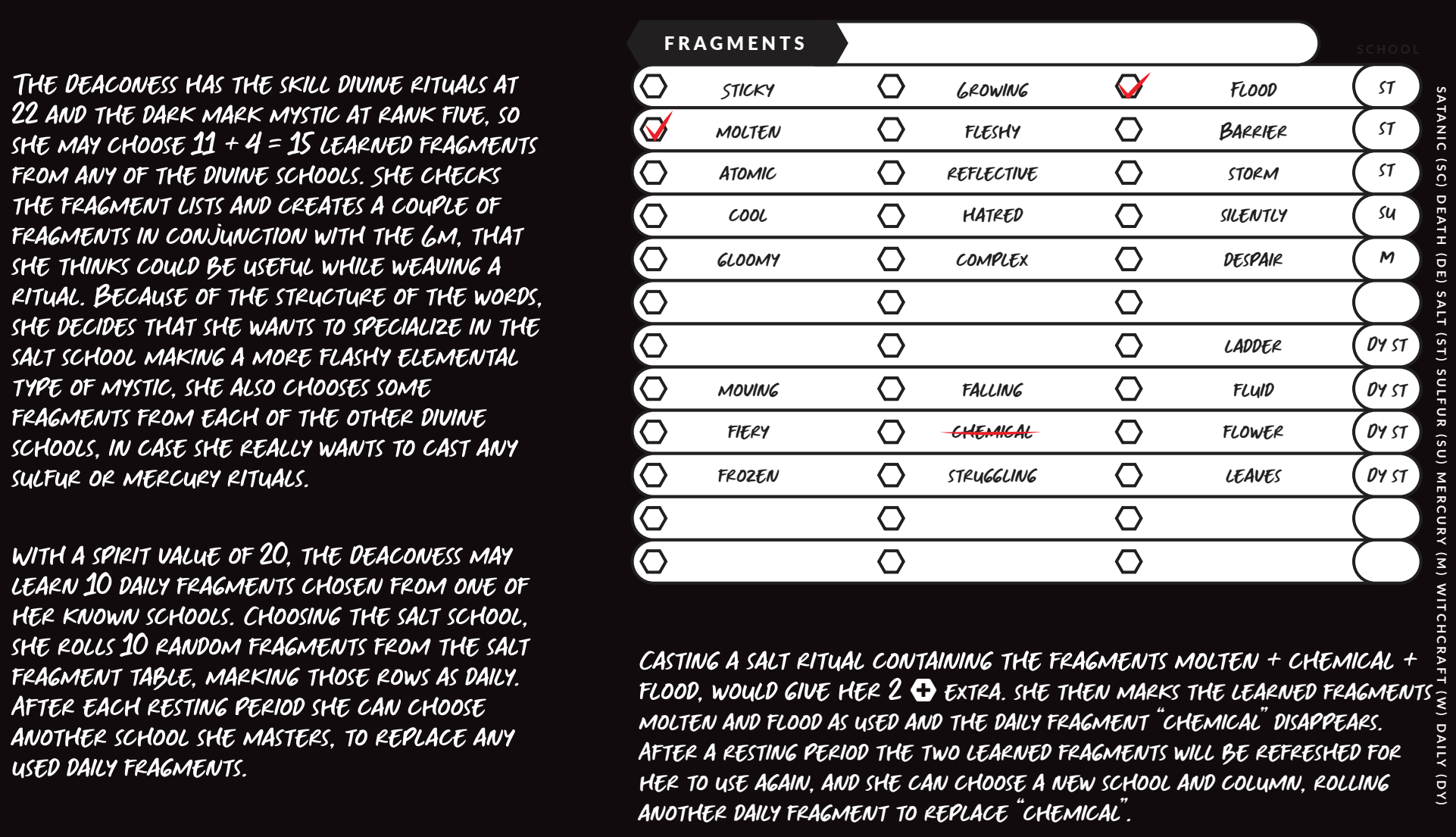
To cast a ritual you need to have learned at least one fragment. Fragments are like tiny pieces of aspects that, together, create ritual effects. Each school has a list from which fragments can be rolled, although they can sometimes be created by you in conjunction with the GM. Each fragment list has them arranged in three complementary columns, and each ritual cast will have one fragment from each column, together forming a sentence-like combined meaning. Whenever you gain learned or daily fragments, write them on your character sheet along with the school they came from.
It is possible to cast a ritual using fragments from different schools, but since each school has its own particular column structure, some fragments are harder or weirder to combine.
Learned Fragments
If you have the dark mark The Mystic or The Witch, you will learn several fragments as you progress. Regardless of your dark marks, you can also learn fragments from various other sources, such as researching tomes, gaining corruptions, and traveling. When learning a fragment, from any source, you can either choose one from a school’s fragment table, or create a completely new one together with the GM. Have the narrative in mind, such as learning the fragment “acid” from a chemistry tome, the fragment “teeth” from a toothy corruption, or “mosquito” from traversing a swamp. The process of learning a fragment usually happens during downtime, unless you learn it through supernatural means or any other reason the GM finds appropriate.
Avoid creating fragments that are too narrow, as thinking more broadly opens up more possibilities.
Learned fragments may only be used once between each resting period (analogous to a good night’s sleep, up to the GM’s discretion), after which they are refreshed. Each learned fragment provides 1 [+] on a success when used to cast a ritual, up to a maximum of three.
Daily Fragments
If you have either The Mystic or The Witch dark marks, you awaken after each resting period with as many daily fragments as half your SPR value rounded down. If you have less than that amount after your rest, earn more from a single school of your choice which is allowed by your dark marks, rolling 1D20 for each. You are free to choose which column to roll from for each of them.
Daily fragments disappear after use and new daily fragments take their place after each resting period. Daily fragments don’t provide [+], but don’t cost anything either.
Improvised Fragments
Regardless of your dark marks, you may choose to assign improvised fragments to one or more columns in a ritual you’re casting, possibly leading to unexpected results. All improvised fragments in a ritual are randomly generated from a single school of your choice of which you have at least one learned fragment, rolling 1D20 on the desired columns of the school’s daily fragment list.
Improvised fragments are never gained nor spent, as they are only rolled at the time of the casting. If you have used all your learned and daily fragments your only option is to cast rituals containing improvised fragments. Each improvised fragment costs you 1 [SAN], and don’t provide any [+]
FRAGMENT INTERPRETATIONS
How you interpret your three fragments is limited only by your imagination. How fragments will actually work, however, is limited by the GM – which is, of course, also based on your interpretation, but more about that later. It is often useful to make a comprehensive sentence out of the three fragments, inserting complementary words as needed. This is not a requirement, though, as it is always possible to come up with meanings and effects for any set of fragments.
- “Open + Speech + From Afar” could illicit a scream from afar, open communication with a soul at another location, or force someone to speak against their will.
- “Sickening + Liquid + Shit” could result in a horrible need to get to the toilet or a horrific shit rain.
- “Knit + Bowels + Horrendously” should probably deal damage, but it could also be a morbid healing ritual for someone who is injured or even a communication ritual with an inner pig demon
Casting a Ritual
Unless otherwise stated, casting a ritual is an action like anything else, and, as such, may be performed any time without the need for any preparations. It must always be the main action, meaning you can never cast a ritual with [+] as an extra action. Rituals can also be triggered by alchemy.
If your intentions with a ritual are too ambitious or world-altering, remember that the GM may always rule it to be a complex task, or that it has the truth “overly demanding” or something of the sort, and thus demands more power in the form of [+], [HP], [SAN] and [AUR] or other kinds of sacrifices – if you want to make great changes, you should also pay a higher price.
In order to cast a ritual, follow these steps:
1. Choose or roll three fragments (one per column) from any combination of learned, daily and improvised fragments. Cross off any chosen learned fragments and erase any chosen daily fragments from your character sheet. Roll any improvised fragments and lose 1 [+] for each.
Beware of improvised fragments, as you cannot change them after they’ve been rolled.
2. Tell the GM your intention with the ritual. This is not guaranteed to happen, though, as the GM will also consider their own interpretation of the fragments used and the result of your check in order to decide the final effects of the ritual.
You can definitely count on the GM to interpret the fragments in the most interesting way for the story, but not necessarily for your character! By the way, audiences with entities as ritual effects can only be chosen when casting death rituals, further explained in the death school description.
3. Roll a check for the Arcane Arts skill related to the most fragments in the ritual. In case there are two or more skills tied for most fragments, roll for the one in which you have the lowest value.
All ritual schools have some broad descriptions of gestures and stuff that rituals usually require. If you cannot meet these requirements properly, the GM might consider this as a negative aspect.
Tip
Cast a Ritual
- Choose up to three learned or daily fragments from your sheet.
- If needed, complete the ritual with random improvised fragments so there are three fragments in total. Pay 1[SAN] for each improvised fragment.
- Declare your intention.
- Make a skill check, add 1th for each learned fragment if you are successful.
- Watch the world burn.
Success
The GM describes the final effect of the ritual based on the fragments and on your intention. Additionally, gain 1 [+] per learned fragment included in the ritual. On a perfect, these extra [+] are also doubled.
Failure
The GM describes the final effect of the ritual based on the fragments and on a wicked distortion of your intention. Additionally, for each fragment used, lose 1 [SAN] if the ritual affects the spiritual or astral world, or lose 1 [AUR] if the ritual affects the physical world or is a death ritual. On a botch, these penalties are doubled. In case it is unclear whether the penalty should be [SAN] or [AUR], the GM decides.
The GM should use their most twisted and strange fantasies when coming up with how a ritual fails or botches, making each of these moments something special and memorable. Use the individual descriptions of failure in the school sections to come up with some really terrifying consequences that haunt the players for months after.
Ritual Effects
When determining the final effect of a ritual, the GM decides its extent and applications based on the story, the chosen fragments, your declared intent, and whether the check was successful or not. This effect can also be enhanced by aspects, truths, and damage with [+] but can default be literally anything, such as narrative events, instant [HP], [SAN] and [AUR] changes, temporary or permanent changes to skill and quality values, and so on.
As a general rule, the GM should be loose in their exposition, not make it too complicated, and always let rituals be one or two steps more powerful than their common counterparts (if there are any).
Tip
If the party has weapons that deal IV damage, let rituals default do VI, [+] can increase this further or add general destruction.
If the party has gear or features that let them levitate, let rituals default make them fly, [+] can increase this effect further by adding speed or other effects.