Conflict
THE ENGINE OF HELL
Verses
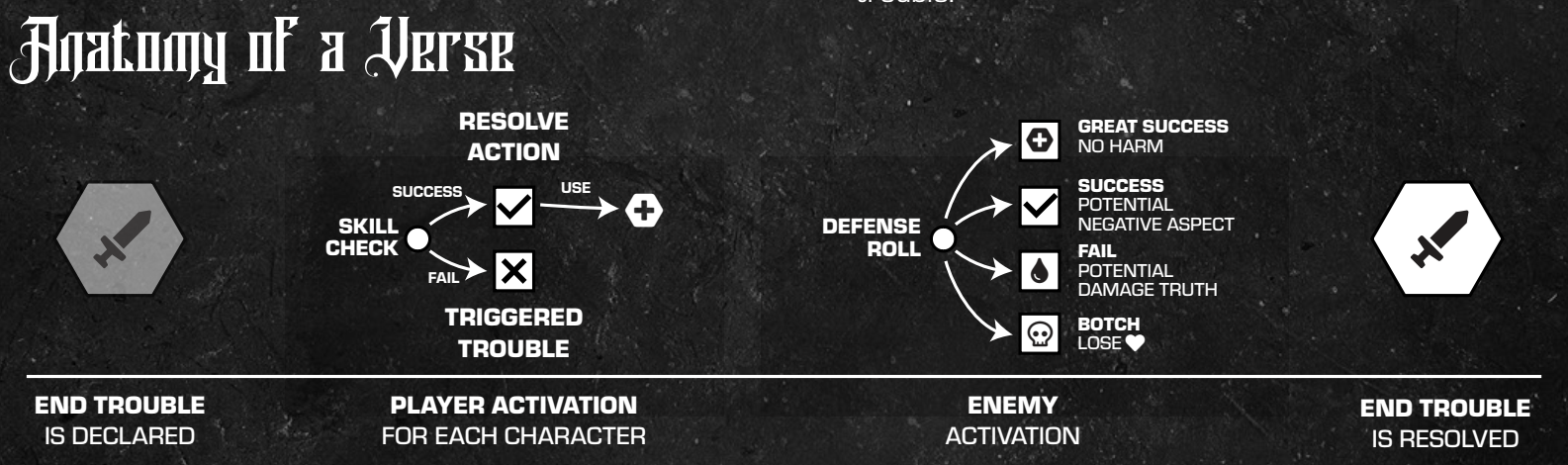
Conflict is divided into verses. Each verse has an end trouble, and the verse starts with its declaration and ends with its resolution. In between that, the party acts first, with each character performing an action, followed by the GM with the adversary activation and the characters’ defense checks. The players are free to choose the order in which the characters will be activated, as long as activations are resolved one at a time.
When unexpectedly entering conflict, some characters may not be able to act in the first verse. Such situations are up to the GM, but they usually involve a check on a relevant quality or skill to give you some chance to act. When all characters have made an action, and the end trouble has been resolved, the verse is over and a new verse starts with the declaration of a new end trouble.
Tip
Verse Summary
1. The GM declares the end of trouble, indicating what will happen unless the characters intervene.
2. The players act and roll one check for a main action, spending [+] to perform extra actions or introduce aspects or truths.
3. The players roll a defense check, and the GM determines what the adversaries are doing, potentially dealing damage/wounds to players or introducing dangers in the form of aspects or truths.
4. The GM resolves the end of trouble, keeping the promise they made unless the players’ actions have prevented or redirected it in some way.
Troubles
Each verse has an end trouble, which describes what will happen at the end of the verse if no one manages to prevent it. The GM may create each end trouble anew or choose one from the adversaries’ descriptions, and must declare it at the beginning of the verse either openly, in riddles, or hinted at as part of the narrative. End troubles with major consequences that will happen later may be declared in earlier verses (usually the first one) for extra suspense.
If the GM believes it will be interesting to not have any actual trouble set for the end of a given verse, they can create harmless or even positive end troubles. You won’t necessarily know that upfront, however, which leads to intriguing dilemmas and plot twists, such as an ally disguised as an adversary that would reveal itself in the end trouble – if only you hadn’t jumped to kill him first…
Tip
Example End Troubles
• The space station will crack and lose pressure.
• The centurion will blast you with the machine gun.
• The Great Mother will trap one of you.
• The Death Wolf will devour one of you.
• The god will scream and tear your souls apart.
• The queen looks at you and smiles.
If you fail or botch any action during the conflict, the GM gets to react with a triggered trouble instead of the usual negative aspect or truth. Triggered troubles may be created anew or chosen from the adversaries’ descriptions. In the case of a botch, they may even mimic the effects listed as end troubles.
Tip
Example Triggered Troubles
• A surprisingly quick slash opens up your stomach, and you can see some of your bowels pour out.
• With howling shrieks, two new adversaries appear from around the corner.
• The creature screams frantically, and, before you know it, it pounces, knocking you over and pinning you to the ground.
• Your gun just clicks – out of ammo already? Or did it malfunction?
• The adversary’s sword starts to burn, her damage is now increased with about 50%.
• The creature opens its large mouth filled with squirming tongues, each with a bloody human face. You all lose 5[SAN]